Hermes Agent Multi-Agent Workflows answers one search intent: how do you run multiple AI agents without turning the project into an untraceable group chat? The useful answer is not “add more agents.” It is to split work into isolated roles, give each role a clear artifact, verify the output, and keep the handoff visible.
Quick answer#
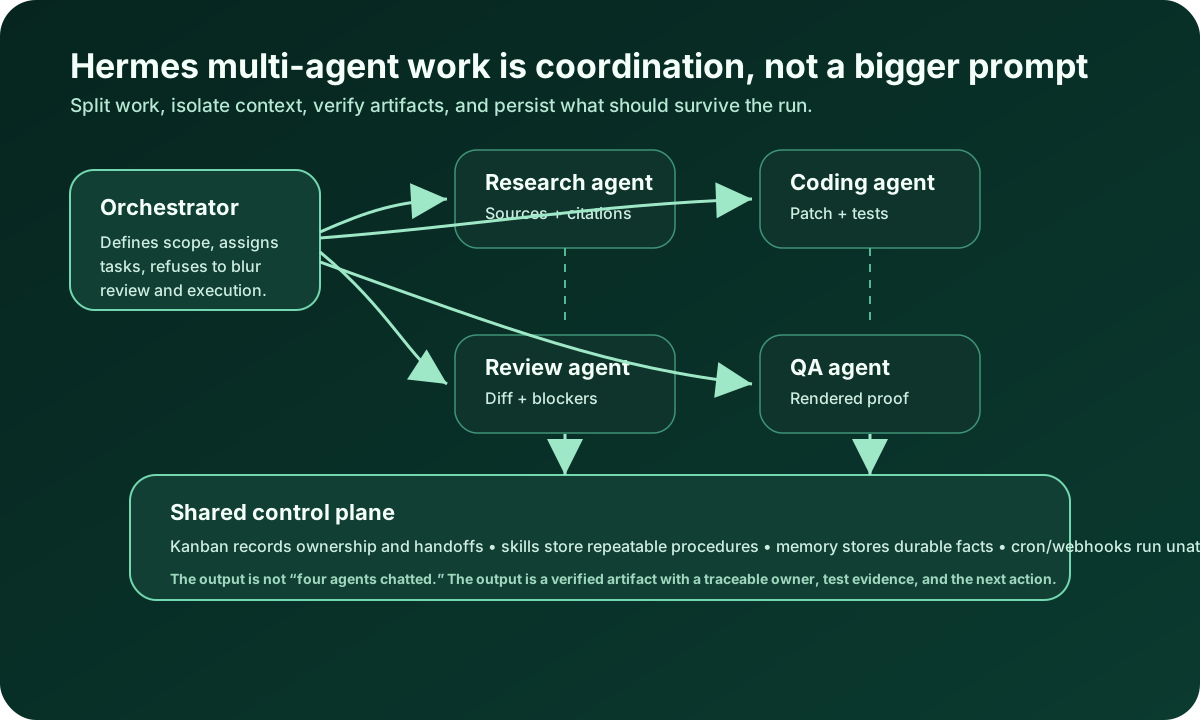
A Hermes Agent multi-agent workflow uses one orchestrator plus focused workers: research, implementation, review, QA, or operations. Each worker gets its own context and tools, returns a verifiable artifact, and records the handoff through Kanban, files, tests, or a final summary. Compared with generic agent frameworks, Hermes is built for practical coordination: persistent memory, reusable skills, cron jobs, browser and terminal tools, messaging gateways, and explicit verification all sit in the same operating loop.
What “multi-agent” means in Hermes#
In Hermes, multi-agent work is not just several model calls. A good workflow has three properties:
- Role isolation — a researcher does not silently edit production code, and a reviewer does not approve work they produced.
- Tool boundaries — each agent gets only the browser, terminal, file, web, or integration tools needed for its job.
- Verified handoffs — the final answer cites a path, diff, test result, screenshot, URL, or Kanban task rather than relying on vibes.
That makes Hermes different from many generic agent frameworks. Framework-first systems often start with abstractions: planners, executors, graphs, memories, and retrievers. Hermes starts from the operator’s workflow: the CLI, project files, tools, the multi-agent feature, persistent memory, skills, cron jobs, and the channels where humans actually read the result.
When to use a multi-agent workflow#
Use multiple agents when parallelism or separation improves the result:
- Research plus synthesis — one agent gathers sources while another turns the evidence into a decision memo.
- Build plus review — one agent implements, another audits the diff for regressions, security problems, and missing tests.
- Content plus rendered QA — one agent upgrades a page, another checks mobile rendering, internal links, and screenshots.
- Operations plus reporting — one agent runs a long job while another summarizes logs and creates a clean handoff.
Do not use multi-agent orchestration just because it sounds impressive. A single Hermes run is better when the task is small, sequential, or highly sensitive. For first-time setup, start with the Hermes Agent setup guide and the troubleshooting guide before introducing workers.
A simple Hermes multi-agent pattern#
A reliable default pattern looks like this:
- Orchestrator writes the brief — outcome, constraints, files, forbidden actions, and verification standard.
- Specialist agents do bounded work — research, code, design, QA, or review in isolated contexts.
- Artifacts come back with handles — paths, URLs, screenshots, command output, test names, or source links.
- Orchestrator verifies — it reads the file, checks the URL, reruns the test, or inspects the screenshot.
- Durable learning is saved — stable facts go to memory; repeatable procedures become skills.
The important part is step four. If a worker claims “uploaded successfully,” Hermes should fetch the URL or inspect the file before telling the human it is done.
Hermes vs generic agent frameworks#
- Parallel research and coding: generic frameworks make you build a planner/executor graph; Hermes spawns focused workers with explicit toolsets and artifact requirements.
- Long-running work: generic stacks usually need custom queues and state; Hermes can use AI agent cron jobs, background processes, or Kanban handoffs.
- Reusable procedures: generic setups store prompts in app code; Hermes saves operational runbooks as Hermes skills.
- Context continuity: generic stacks often add a vector database; Hermes uses durable memory for stable facts and session search for past work.
- Human notification: generic systems need a chat integration; Hermes can use Telegram, Discord, email, or other gateways.
- Production alternative: generic systems assume you self-host everything; Hermes supports self-hosting when you want control, or FlyHermes when you want the outcome without server maintenance.
The trade-off is clear: generic frameworks can be great for embedding agent logic inside an application. Hermes is better when the problem is an operational workflow that touches real tools, files, browsers, APIs, schedules, and humans.
Example: build-review-QA loop#
Imagine a website task: “upgrade two SEO pages and prove they render correctly.” A Hermes multi-agent workflow could split it this way:
- Content worker updates titles, descriptions, examples, FAQs, and internal links.
- Reviewer checks search intent, link quality, and whether the page accidentally duplicates another article.
- QA worker runs formatting tests, strict SEO-link checks, lint, build, and mobile/desktop rendered probes.
- Orchestrator verifies the diff and writes the final report with screenshot paths and command output.
This is exactly where multi-agent coordination pays off: the work is parallelizable, each role has a different failure mode, and the final output must be more than a paragraph of prose.
Checklist before adding more agents#
- Is there a clear artifact for every worker?
- Can the orchestrator verify each artifact without trusting the worker’s self-report?
- Did you keep secrets in config or environment files, not prompts?
- Did each worker get the minimum toolset it needs?
- Is repeated know-how captured in a skill instead of buried in a chat?
- If the workflow must run while you are away, should it be a cron job, a webhook, or a Kanban pipeline?
Where Kanban fits#
For short in-session parallel work, Hermes can use subagents. For work that should outlive one run, route it through Kanban: create specialist cards, attach dependencies, and let each worker complete with a structured handoff. That makes multi-agent work auditable instead of ephemeral.
If you are building an always-on system, combine Kanban with VPS hosting or a managed route. If maintaining Linux, Docker, gateways, backups, and restarts is not the point of your business, FlyHermes is the simpler commercial path.
Make every worker prove its handoff#
Parallel work amplifies weak verification. Before delegating, define one artifact and one acceptance test per worker. Research should return source URLs and quoted evidence; implementation should return changed paths and tests; QA should inspect the integrated result rather than repeat the implementer’s summary. If a worker cannot provide a concrete handle, mark the result unverified. Use the Hermes troubleshooting proof ladder for claim → artifact → local test → integration → production verification, and preserve the final state with the session handoff checklist.
Pantheon gives durable teams a shared surface#
v0.21 moves multi-agent work beyond temporary delegation: named profile-backed Bots share group chats and can use hermes peer for durable handoffs. See the Pantheon release guide for the boundary between Bots, peers, subagents, and managed hosting.